Origins:
As in most ‘developing’ countries, there are few opportunities for less privileged Ugandan children. In a country with 65% adult unemployment their futures are restricted to manual labour, insecure, small-scale trading, or subsistence farming. The state provides only primary level education, commonly with classes of more than 150, and there is no access to training that can produce nurses, engineers, or farmers able to take advantage of modern technologies. As a result, the economy as a whole suffers, lives are precarious and unrest is never too far away.
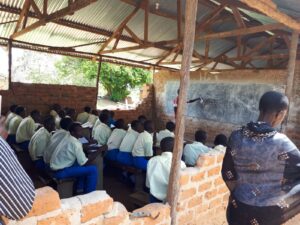
Against this background a remarkable local family in Northern Uganda founded a school to provide secondary education … effectively to GCSE, for deserving children from less privileged backgrounds. In 2011 facilities were rudimentary, but the vision and commitment of the founders was inspiring.
Keframa High School in 2011
Keframa School Build:
The founders’ commitment has been infectious. It inspired a group of Nottinghamshire friends to establish the UK charity, Keframa School Build. Land was purchased and funds raised to provide a building capable of teaching 300 children. Much of the funding was the result of sponsored cycling.
The main school building, a kitchen, latrines and a borehole were opened in 2019.
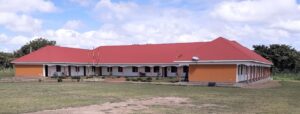
Keframa High School in 2019
Original student and staff accommodation was very basic and cramped. A new girls’ dormitory and a pair of staff houses were added at the beginning of 2025.
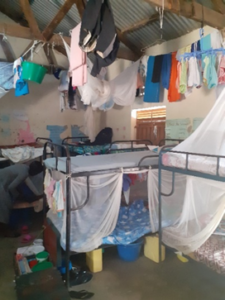
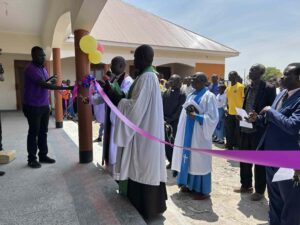
Original Student Accommodation Opening the new Girls’ Dormitory in February 2025
Growth and Consolidation:
During the Covid pandemic all education in Uganda ceased for nearly two years, economic activity plummeted, and in the North, with two failed harvests, starvation and deaths followed. Without the school staff’s willingness to maintain pupil contact by whatever means, and for little pay, the school would have failed.
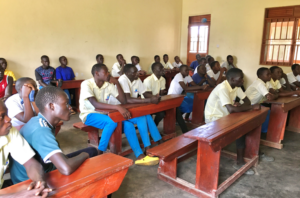
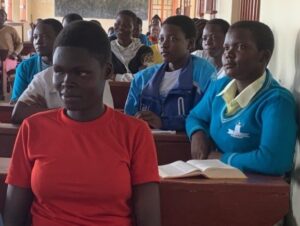
Keframa High School in 2024
Future challenges:
Growth of the school is putting a strain on essential infrastructure and facilities. Although sponsorship is a central feature of the school’s business model, fee-paying students are the main source of income. They have to be attracted by a reputation for quality.
Funding is needed:
- To improve the storage of solar powered electricity, so that students can reliably study outside of daylight hours.
- To improve the water supply which has been challenged by the new dormitory.
- For additional beds.
- For additional desks.
- For additional laboratory equipment.
- For additional information technology.
- For textbooks and consumables.
- As sponsorship. The long-standing individual student sponsorship scheme needs more sponsors (at £25/month for 4 years) to enable more of the rural poor to attend.
